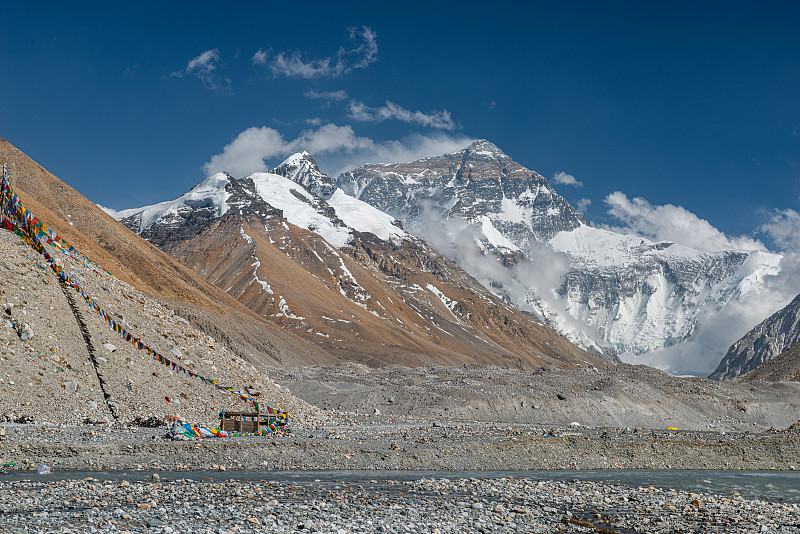
What to see here
Base Camp sits at the head of the Rongbuk valley in Tingri County at about 5,200 m, the highest point ordinary travellers reach. What you see is the north face of Everest, a regular pyramid, with the gravel flats of the Rongbuk glacier directly in front and the valley walls closing in on both sides — the view is narrower than expected and stronger for it.
There is no busy “camp” here, only wind, stone and prayer flags. Visitor activity centres on Rongbuk monastery at 5,100 m, one of the highest monasteries anywhere, its courtyard facing the peak, with the cairns and flags beside it. Beyond that lies the climbers' area, closed to ordinary visitors.
The light is what you come for. At sunrise the first beam hits the summit and the snow goes from grey-blue to pink to gold in under ten minutes; at dusk the reverse, the gold fading to grey. By midday the summit is often under cloud, so seeing it is luck — build two mornings into the itinerary.
The story behind this place
The monks at Rongbuk barely came down in winter. Older accounts describe no road at all in the valley, a journey of days on foot, with grain and butter carried in by yak; the isolation is also why so many old murals and ritual objects survived here.
Everest is Chomolungma in Tibetan, “goddess mother”. Local tradition counts the peak as the third of five goddesses, the one who governs long life; herders passing the passes scatter tsampa and hang flags to ask her for a safe road. That framing sits closer to daily life than “the highest mountain in the world”.
Driving there and visiting
From Lhasa via Shigatse and Tingri to the Rongbuk valley, two days is the sane pace. Beyond Tingri there are border checkpoints and every paper must be in order. At the reserve gate you switch vehicles; your own car stays in the marked car park and cannot enter the core zone.
- The border permit must be arranged in advance and carried. Without it the checkpoint stops you and the whole leg collapses.
- Visitors stay around Rongbuk at over 5,100 m: keep it to an hour or two, and descend at the first headache.
- Before sunrise it can be well below freezing. Down jacket, hat, gloves, hand warmers — do not count on the car staying warm.
- Rules are strict: carry all rubbish out, do not collect stones or take any specimen. Fines apply.
- The reserve road is gravel with a low speed limit. Follow the vehicle ahead, no overtaking, no off-road.
- Mobile signal is patchy — tell people at home in advance. Bring cash; cards do not always work.
Pairing it with nearby stops
Everest usually runs as one line with Shigatse and Gyantse: Lhasa, Yamdrok, Gyantse, Shigatse, Tingri, Rongbuk, returning the same way or via Sakya. Four to five days is comfortable, and two mornings for the gold on the summit lifts your odds considerably.