What to see here
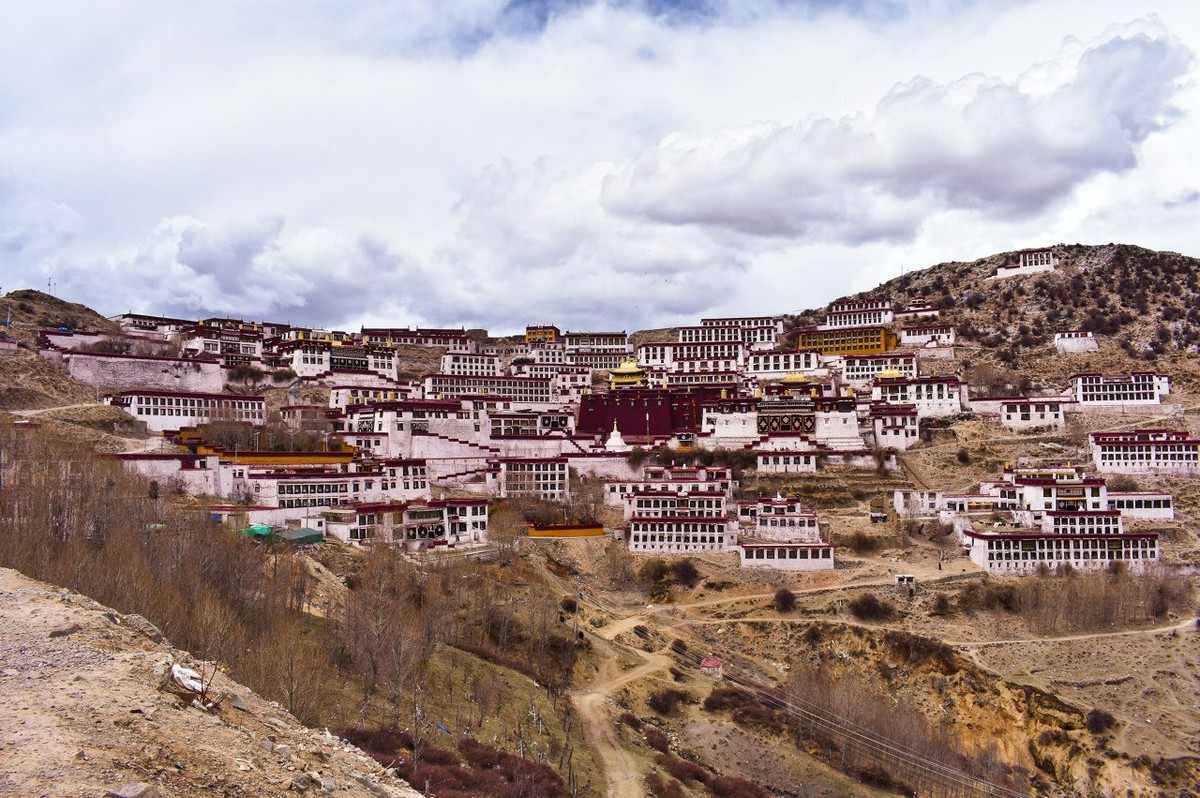
Ganden stands on the summit heights of Wangbur Mountain in Dagzê County east of Lhasa, at about 4,300 m. Tsongkhapa founded it himself in 1409, and the Gelug school began here, which is why it is called the mother monastery. It is not one great building but a settlement along the ridge: the Tsogchen hall, the Yangbajain college, two dratsangs and rows of monk housing, white walls and red eaves stepping down the slope.
See the Tsogchen hall and Tsongkhapa's reliquary first. The columns, beams and painted surfaces keep to old methods, and the reliquary is silver-clad and set with stones — the most solemn place in the house. The Yangbajain tantric college is the other: dense statues and murals in very dim light. Much of the original fabric was lost in the later twentieth century and the buildings now standing were rebuilt to the old form, so you can read the difference between old and new work.
The real draw is outside the walls. A kora runs along the ridge, about an hour and a half for the circuit, the monastery's roofs on one side and the whole Lhasa valley on the other, snow peaks visible in clear weather. This is the path local people walk most, heavy with prayer flags and wind.
The story behind this place
When Tsongkhapa built here, the Gelug school did not yet exist. He read the land as a reclining elephant and a proper seat for a root monastery; once it stood he took the first throne himself, and his successors hold the title Ganden Tripa — a position of the highest standing in the Gelug lineage, regarded as Tsongkhapa's heir.
The monastery also tells a story of the reliquary. After Tsongkhapa died his disciples enshrined the body in a silver stupa on this spot, and for centuries it has been one of the most important pilgrimage points of the school. On the twenty-fifth day of the tenth Tibetan month, the anniversary of his death, the monastery fills with butter lamps — the Festival of Lights — and it is the busiest day of the year at Ganden.
Driving there and visiting
East from Lhasa toward Dagzê, about forty kilometres, with a long winding climb at the end: narrow but paved. A foreign-plate car can drive all the way to the car park at the monastery, which is small — early is safer.
- Buy the ticket at the entrance by the car park, real-name on your passport. Park on the platform in front of the monastery, not on the kora path.
- The ridge kora takes an hour to ninety minutes with no shelter at all: wind and hard sun, hat and water essential.
- The monastery sits at 4,300 m, six hundred metres above Lhasa. Walk slowly, and do not come straight up in your first two days.
- No photography, hats off, no noise in the Tsogchen hall. The queue at the reliquary is busy — do not push.
- On the Festival of Lights the road is narrow and full; leave at dawn or park at the foot and shuttle up.
- Use a low gear on the long descent rather than riding the brakes, and watch for loose gravel after rain.
Pairing it with nearby stops
Ganden is east of Lhasa and works as a half day on its own: leave early, see the monastery and walk the kora, back in the city by lunch. To see all three of Lhasa's great houses, take Ganden on one day, then Drepung in the morning and Sera in the afternoon of another.