What to see here
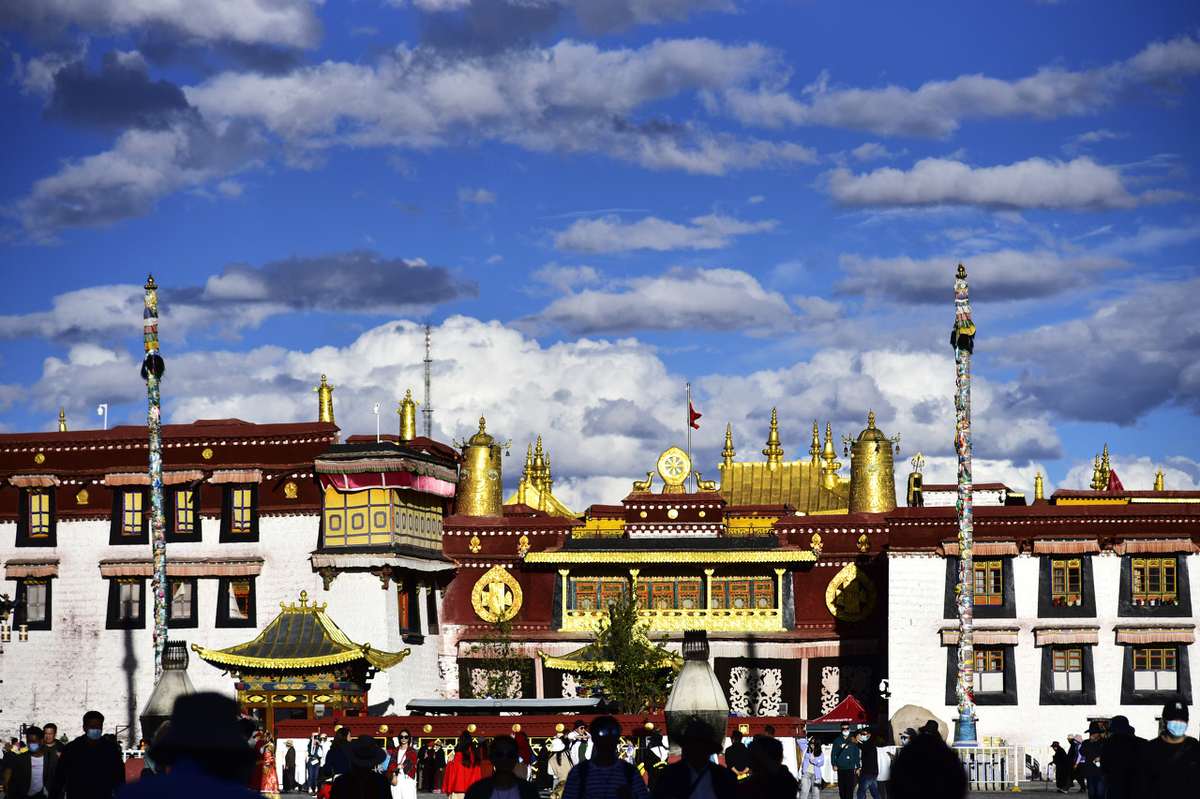
The Jokhang sits at the heart of old Lhasa. Founded in the seventh century, it was enlarged repeatedly and ended up as a rare blend of Tibetan temple styles. Its most precious object is the Jowo Shakyamuni, a life-size statue of the Buddha at twelve, brought in from the Tang court and regarded as the holiest image in Tibet. Pilgrims arriving in Lhasa come here first to add butter lamps, offer scarves and gild the statue.
Look at three layers. In the square outside stands the Tang-Tubo Alliance Pillar, erected in the ninth century with the treaty carved in both Chinese and Tibetan — a primary document of that relationship. Inside, the Jowo chapel holds the statue with a row of butter lamps that never go out. Higher up, the gilded roofs, the wheel of dharma with its two deer, and the sea of old-town rooftops beyond them make the best viewpoint in the city.
The temple is small but the atmosphere is the densest in Tibet. The halls are dark and heavy with butter, and pilgrims queue to press tsampa, barley and banknotes towards the statue, the line curling around in rings. Visitor lanes and pilgrim lanes are kept separate: follow the signs, do not cut in, and never use flash inside.
The story behind this place
A widely told story explains the site. This was once a lake called Wotang, and when Songtsen Gampo decided to build a temple for his Nepalese bride, Bhrikuti, the water would not stay filled in. White goats carried earth basket by basket until the lake was closed and the temple could stand. The old name of Lhasa, Rasa, is said to mean goat (ra) and earth (sa).
Another version links the temple to Princess Wencheng. By the geomancy of the Central Plains, she is said to have seen Tibet as a supine demoness, with the Wotang lake on her heart, and a temple had to be raised there to pin it down. Both versions are still told today; pilgrims treat the temple as proof of vow rather than a page of architectural history.
Driving there and visiting
The Jokhang is in the core of the old town, where streets are narrow and much of the area is pedestrian. A foreign-plate car has nowhere to stop and cannot enter. Leave the car in a proper car park on the edge and walk in from Yutok Road or Dajielin Road — a few hundred metres. Early morning and late afternoon are the densest, so allow extra time.
- Tickets are real-name on your passport and there are two security checks. No photography, no hats, no loud talk inside, and do not point at images.
- Mornings belong to pilgrims and the queue into the chapel is long. To see the statue and the halls properly, go after two or three in the afternoon.
- Many people prostrate in front of the temple. Walk around them, never step on their mats, and do not photograph faces close up from the front without asking.
- You can climb to the roof level for the view over the old town. It is windy up there: do not lean on the railings or sit on the eaves.
- The kora follows Barkhor Street clockwise, a little over a kilometre. Go with the flow; walking against it blocks people.
- Carry your Tibet permit and border permit. Going south to Lhokha or west to Shigatse needs separate papers — plan those into the itinerary.
Pairing it with nearby stops
The Jokhang and Barkhor are one unit: circle Barkhor first, enter the temple, then wander the lanes and tea houses — half a day. The Potala is a kilometre and a half northwest and fits the other half of the same day. For a quieter monastery, Sera is north and its debate session runs in the afternoon.