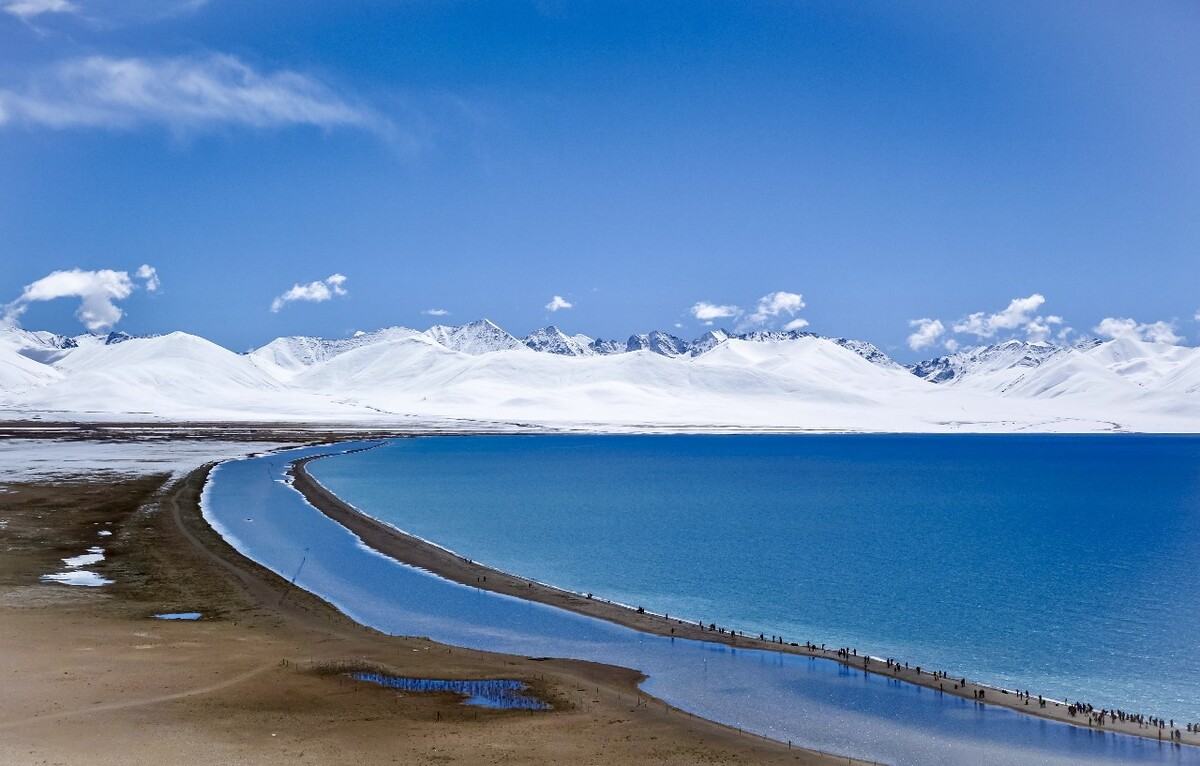
What to see here
Namtso lies in Damxung County north of Lhasa at 4,718 m, the second largest salt lake in Tibet and one of its three sacred lakes. The road in climbs the Lagen La pass at 5,190 m — wind, dense prayer flags and the hardest hour of the trip — before the lake spreads out below.
The peninsula of Tashi Dor is what most people see. It pushes into the water with a bay on either side and low hills and cairns in the middle; from the high point you can see lake in two directions at once. Tashi monastery sits on the peninsula, the joined-palms rock in front of it is the landmark, and the kora starts there.
Half of Namtso is the light. Early morning the surface is flat and the snow peaks reflect cleanly; by midday cloud thickens and the water turns grey-blue; at dusk, as the sun drops to the ridge, the lake goes deep blue and the shore stones glow red. Stay overnight for those two hours; a day return usually means seeing it only at noon.
The story behind this place
Tibetans pair the lake with the mountain: Nyenchen Tanglha is the husband, Namtso the wife, and the water takes the mountain's mood — snow on the peaks and the lake goes milky, the mountain calm and the lake clears. Herders have told this for generations, and it explains why pilgrims look at the mountain before the water.
The lake kora is the heaviest custom here. The full circuit traditionally takes a fortnight or more, past monasteries, meditation caves and springs, and the crowds are greatest in the sheep year of the Tibetan calendar. Most visitors now walk only the small circuit on Tashi Dor, an hour or two. The cairns are built high — circle them clockwise, do not move stones or step across the prayer flags.
Driving there and visiting
From Lhasa via Damxung to the lake is over four hundred kilometres return, tight in a day. The gate is on the Damxung side; after the ticket the road climbs to the pass and drops to the shore, the last stretch paved, and a foreign-plate car can drive to the Tashi Dor car park.
- The lake is at 4,700 m and the pass at 5,100 m. Coming up from Lhasa in one day is when altitude sickness hits hardest: headache or nausea means descend, not push on.
- Buy the ticket at the gate, real-name on your passport. In high season the car park only empties early.
- Day and night temperatures swing hard; carry a down jacket even in summer. When the wind rises the felt temperature drops ten degrees at once.
- Do not drive onto the beach or meadow — soft sand traps the car. Park and walk down.
- Do not move cairns, prayer flags or clay offerings; walk the kora clockwise; leave meditators alone.
- To stay over, use the simple board rooms or tent camp on the peninsula and book ahead. Nights are cold; a sleeping bag helps.
Pairing it with nearby stops
Namtso usually pairs with Yangbajain and Damxung over one or two days: the pass and the lake going out, hot springs coming back. Leaving Tibet northward on the Qinghai road, Namtso sits right on the way — fold it into the drive and save a day.