What to see here
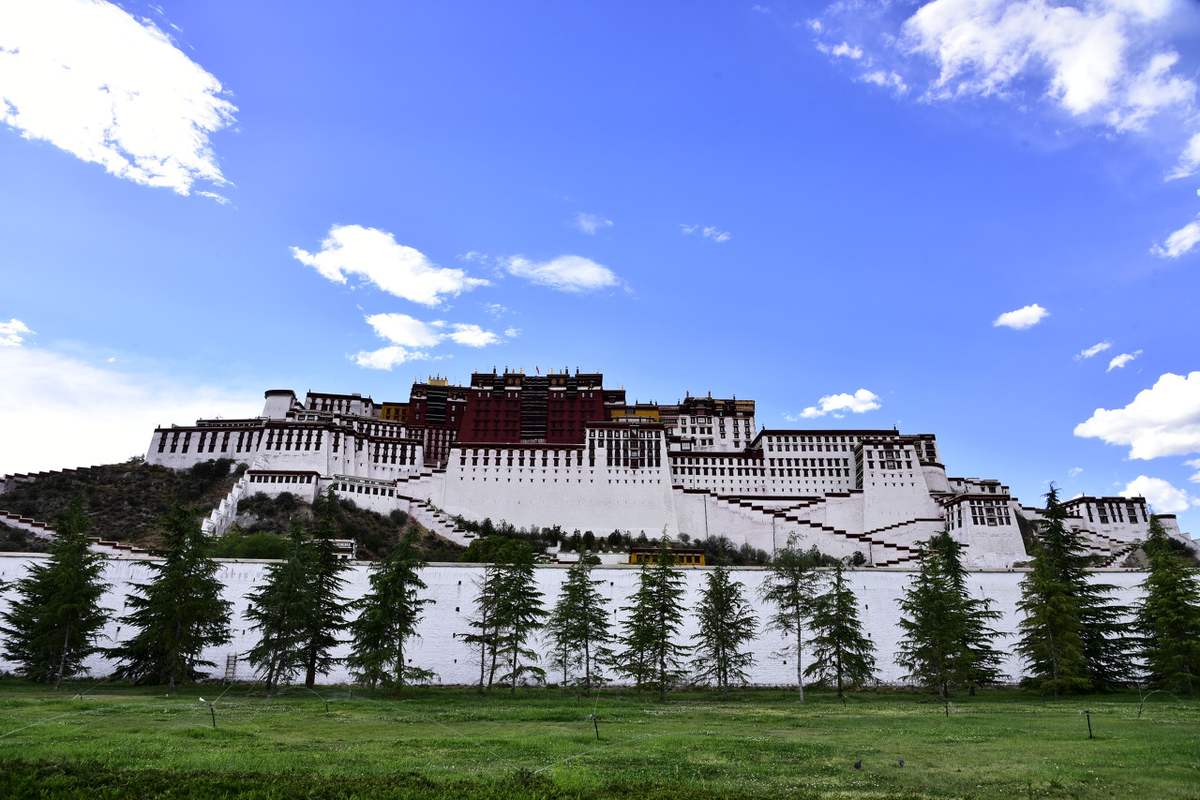
The Potala Palace climbs the Red Hill (Marpo Ri) in the middle of Lhasa, rising about 115 m from the foot of the hill to the top in thirteen storeys and running roughly 360 m east to west. It is the largest palace-fortress complex on the plateau, inscribed as a World Heritage Site in 1994, and the restoration since then has kept to traditional methods — the white of the walls and the gold of the roofs are made the old way.
Read the building in two halves. The lower White Palace held the offices and living quarters of government, with the East Assembly Hall and the East Sunshine Hall in this section. Above and at the centre, the Red Palace with its ochre-red walls is the religious core: the reliquary chapels of the successive Dalai Lamas, assembly halls, murals and thangkas. The visiting route enters on the east side, works upward and exits on the west, without doubling back.
The murals and reliquaries in the Red Palace are what repay slow looking. The chapel of the 5th Dalai Lama is the largest, its stupa gilded and set with turquoise, and the walls around it carry tier on tier of painting — the building of the palace, Buddhist narratives and the envoys who came and went. Timed entry splits the crowd into blocks; walking faster than your own pace means seeing nothing, so keep to your rhythm instead of chasing a group.
Allow two hours for the palace itself and another hour for the circuit outside if you want the full picture. Most people underestimate the stairs at 3,650 m and overestimate how much they will absorb indoors.
The story behind this place
The first palace on the Red Hill was built in the seventh century under Songtsen Gampo as the seat of the Tubo court, and most of it was lost afterwards to war and lightning. What stands today was rebuilt in the seventeenth century: work began on the hill in 1645 under the 5th Dalai Lama, the White Palace was finished first, the Red Palace was added from 1690, and later generations kept extending it.
The whitewash is still done the old way once a year. In the ninth Tibetan month craftsmen mix lime with milk, honey and sugar and pour it down the walls from above, which is why the surface carries a faint cream tone and holds up better against plateau weather. The white you see from the foot of the hill is that coat of lime.
Driving there and visiting
The palace sits in the middle of the city, ringed by restricted streets, no-stopping zones and security checkpoints, and a foreign-plate car cannot pull up to the square in front. Park at your hotel or a proper car park nearby and walk or take a taxi; the checks are heaviest along Beijing Middle Road and Nyangrain Road, so do not stop on the shoulder.
- Tickets are real-name and timed, entered on your passport. In high season (May–October) the daily quota is tight and groups must apply days ahead; individual visitors rarely get a same-day slot, so leave slack in the plan.
- The visit takes about two hours. No photography and no hats inside, bags go through security, and drones are banned across the whole city.
- The stairs start at 3,650 m. Walk slowly, talk little, stop every flight — that beats one long push.
- Three viewpoints for the full face: the Chokpori (Yaowang Shan) platform for the classic front view in morning light, Dragon King Pond in Zongjiao Lukang Park for the reflection, and the far side of Nanshan Park for the whole ridge.
- A kora circuit runs around the foot of the Red Hill. Go clockwise, give way to pilgrims, and never walk against the flow.
- Carry your Tibet permit and border permit: checkpoints and the site itself may ask. Heading on to Shigatse or Everest needs separate border papers.
Pairing it with nearby stops
The Potala, the Jokhang and Barkhor Street sit within walking distance of each other: sunrise on Chokpori for the front view, the palace in the morning, the Jokhang after lunch, and Barkhor in the evening with the crowd. Norbulingka is three kilometres west, a large garden that takes its time — put it on the second morning with the Tibet Museum.